- CPSY’s Home Offline UPS S-series covers 500VA/300W through 2000VA/1200W for 110/120VAC applications.
- Choose by both watts and VA. A UPS can reach its watt limit before its VA rating looks full.
- AVR, simulated sine-wave output, battery chemistry, ports, and active-PFC compatibility deserve more attention than the headline capacity.
- Runtime depends on the connected load, battery condition, and operating temperature; confirm it with CPSY’s discharge data for the exact model.
- For U.S. deployments, verify output receptacles, transfer behavior, replacement batteries, certifications, and warranty terms before placing a volume order.
Key Takeaways: What U.S. Buyers Should Verify Before Choosing an Offline UPS
An Offline UPS is a sensible choice when your main problem is a short outage, a brownout, or enough time to shut down a PC and network device cleanly. It is not a substitute for a double-conversion online UPS in a data center or a facility with severe voltage distortion. That distinction saves buyers money and prevents disappointing installations.
CPSY’s Home Offline UPS S-series is aimed at home offices, workstations, laptops, routers, and small networks. The listed range runs from 500VA/300W to 2000VA/1200W, with 110/120VAC input, AVR, simulated sine-wave battery output, lead-acid batteries, and LED or LCD display options. Optional communication and RJ11/RJ45 protection ports may matter if you need shutdown signaling or telephone and network-line protection.
Before buying, ask for the exact model datasheet rather than selecting from VA alone. Confirm the maximum watt output, battery configuration, expected runtime at your actual load, transfer characteristics, outlet type, and replacement battery part number. Those details determine whether the unit works in your rack, office, or home—not the product family name by itself.
Offline UPS FAQs: Topology, Runtime, Active-PFC Compatibility, and Battery Replacement
Is a CPSY Home Offline UPS a standby UPS or a line-interactive UPS?
CPSY markets the S-series as a Home Offline UPS, which generally means a standby topology: utility power normally passes to the load, and the inverter starts when the input moves outside the acceptable range. The published product information also lists AVR, or automatic voltage regulation. That feature needs careful interpretation because AVR is more commonly associated with line-interactive designs.
For a purchase specification, ask CPSY whether the AVR corrects voltage while the load remains on utility power and whether the inverter is active during that correction. If so, the unit has line-interactive operating behavior even if the commercial name remains offline UPS. Also request the transfer-time specification and the battery waveform description. The S-series is listed with simulated sine-wave battery output, which is normally suitable for many PCs, monitors, routers, and office electronics, but it is not the same as a pure sine-wave output.
How do I choose UPS capacity using watts and VA, and how should I assess expected runtime?
Start with the equipment nameplates, then measure the real load if the installation matters. Include the desktop or workstation, monitor, external drives, router, switch, modem, and any small network appliance that must stay powered. Use the UPS watt rating as the hard limit and the VA rating as a second check. A load can fit under the VA figure while exceeding the available watts, especially with equipment that draws current inefficiently.
Runtime should be judged at your expected operating load, not from the no-load headline. Ask for a runtime table or test result for the exact S-series model, battery pack, and discharge condition. Lead-acid batteries lose capacity with age, heat, and repeated deep discharge. If your goal is controlled shutdown, a shorter runtime may be adequate. If you need a router and security system to remain online through longer interruptions, specify that requirement separately and consider a larger battery system or a different UPS topology.
CPSY S-Series 120V Offline UPS Specifications: Models, Capacity, AVR, Ports, and Protection Options
The CPSY S-series gives U.S. buyers a useful capacity spread without forcing every home-office load into a large commercial UPS. The published range starts at 500VA/300W and extends to 2000VA/1200W. That covers a single laptop and router at the small end, then moves into desktop workstations, monitors, storage devices, and small-office network equipment. Select the model by the equipment that must remain powered during an outage, not by every device in the room.
| Specification | CPSY S-Series information | What to verify before ordering |
|---|---|---|
| Capacity range | 500VA/300W to 2000VA/1200W | Exact model watt limit and recommended operating load |
| Input | 110/120VAC | Input plug, frequency, and site voltage |
| Voltage control | AVR listed | Correction range and transfer behavior |
| Battery output | Simulated sine wave | Compatibility with active-PFC power supplies and motors |
| Battery | Lead-acid configuration | Replacement part, access method, and service interval |
| Interface options | LED/LCD; optional communication and RJ11/RJ45 protection | Exact ports, software support, and connector layout |
The least visible specification is often the most expensive one: compatibility. Modern desktop power supplies with active power-factor correction can be sensitive to simulated sine-wave output, particularly during transfer or when the supply is heavily loaded. Many systems work normally, but a buyer should test the actual PC and monitor combination rather than assume every active-PFC supply will behave the same way. For equipment that cannot tolerate that uncertainty, ask CPSY about a pure-sine or online alternative.
How to Select, Install, and Maintain a 120V UPS for a PC, Workstation, Router, or Small Office Network
A small UPS installation fails more often from poor load planning than from a defective inverter. Laser printers, space heaters, copiers, and high-wattage audio equipment should not be placed on the battery-backed outlets unless the manufacturer specifically permits it. Their startup or heating loads can overload a compact unit immediately. Keep the protected load limited to electronics that need continuity or an orderly shutdown.
- List every device that must stay online and record its rated watts, startup behavior, and power-supply type.
- Match that load to the CPSY model’s watt and VA limits, leaving practical headroom for USB devices, extra monitors, and future additions.
- Confirm that the wall outlet, plug, output receptacles, and input voltage match the U.S. installation.
- Connect only critical equipment to battery-backed outlets; use surge-only outlets for noncritical accessories if provided.
- Test the installation under load by simulating a brief outage and checking that the PC, router, monitor, and network link remain stable.
- Record the installation date, inspect alarms and display readings, and replace the lead-acid battery when runtime drops materially or the unit reports a fault.
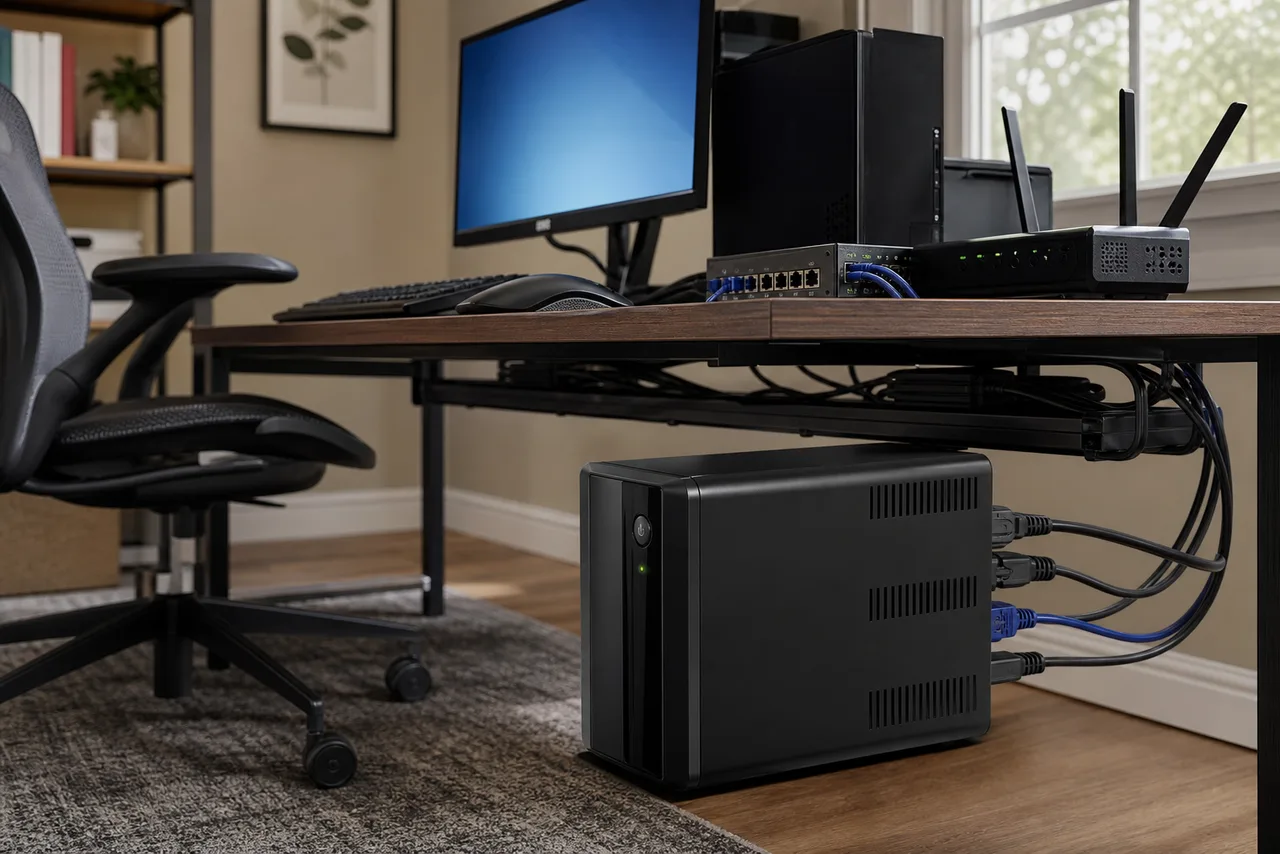
Place the UPS where air can circulate. Do not bury it under a desk against a wall or put it beside a radiator. Heat shortens lead-acid battery life, while dust can raise internal temperature and interfere with fans or vents. For a PC, install the vendor’s shutdown software when communication is supported; runtime is useful, but controlled shutdown protects file systems and avoids corrupted storage.
CPSY Home Offline UPS for U.S. OEM, Reseller, Business, and Home-Office Buyers: Model-Level Documentation and Quote Requests
CPSY sells into home-office, workstation, server, network, industrial, data-center, distributor, and OEM/ODM channels. That makes the exact documentation package more important than a generic product page. A reseller may need carton dimensions, labels, serial-number rules, replacement battery information, and compliance files. An OEM customer may need enclosure drawings, connector changes, display options, firmware behavior, and production lead times.
CPSY states that its UPS products comply with CE, RoHS, IEC, BS, UL, TUV, and SAA standards and that the Home Offline UPS carries a two-year warranty. Ask which standard or test report applies to the exact U.S. model and configuration you intend to sell. Certification language should be tied to a model number, not copied across an entire product family without verification.
For a quote, send CPSY the input voltage, required outlet type, connected equipment, target watt load, desired runtime, display preference, communication requirement, network or telephone protection requirement, annual quantity, and destination. If you are evaluating the CPSY Home Offline UPS range, request the model-level datasheet and a runtime chart before comparing unit prices. For a larger deployment, ask whether a line-interactive, online, rack-mount, lithium, or modular UPS would better fit the load and service plan.
Request the Right CPSY UPS Configuration
Send CPSY your load, runtime, voltage, outlet, battery, display, and communication requirements. Ask for the exact U.S. model documentation, compatibility guidance, and replacement-battery details before you place an order.
Visit Official Website →