- English
- Español
- Português
- русский
- Français
- 日本語
- Deutsch
- tiếng Việt
- Italiano
- Nederlands
- ภาษาไทย
- Polski
- 한국어
- Svenska
- magyar
- Malay
- বাংলা ভাষার
- Dansk
- Suomi
- हिन्दी
- Pilipino
- Türkçe
- Gaeilge
- العربية
- Indonesia
- Norsk
- تمل
- český
- ελληνικά
- український
- Javanese
- فارسی
- தமிழ்
- తెలుగు
- नेपाली
- Burmese
- български
- ລາວ
- Latine
- Қазақша
- Euskal
- Azərbaycan
- Slovenský jazyk
- Македонски
- Lietuvos
- Eesti Keel
- Română
- Slovenski
- मराठी
- Srpski језик

2026 Ultimate Guide to 12V Mini UPS: Wholesale B2B Solutions
In the modern smart home and telecom infrastructure landscapes, constant uptime is no longer a luxury—it is a critical requirement. The CPSY® 12v mini ups provides comprehensive protection for computing, networking, and security hardware, maintaining operational continuity during localized power anomalies or complete grid failures.
Key Takeaways & Executive Summary
- CPSY Premium Quality: Ranked among the top 10 UPS manufacturers in China, complying fully with stringent EU and North American standards.
- Double Warranty: Backed by a robust 2-year warranty on electronic components and a 1-year warranty on dynamic battery cells.
- Supercharged Performance: Delivers advanced rapid-charging circuitry, reducing charging times by 50% compared to peer products.
- Total Customization: Supports full OEM/ODM parameters including custom plastic/metal chassis materials, branding, long-run cell capacities, and personalized packaging.
- Integrated AVR: Employs active boost and buck Automatic Voltage Regulation for comprehensive overload, discharge, and overcharge protection.
Executive Summary & Key Takeaways: Dominating the US Telecom & Security Market
As networks expand across the United States, keeping edge units like CCTV security cameras, GPON/EPON terminals, and smart hubs live during brownouts is vital. CPSY bridges the gap between commercial reliability and functional affordability. US distributors and service providers face unique climatic and grid challenges. High-volume buyers require power backup solutions that optimize structural safety while reducing maintenance cycles. The wholesale 12v mini ups solutions manufactured by CPSY are engineered precisely to scale alongside these demanding infrastructure needs.
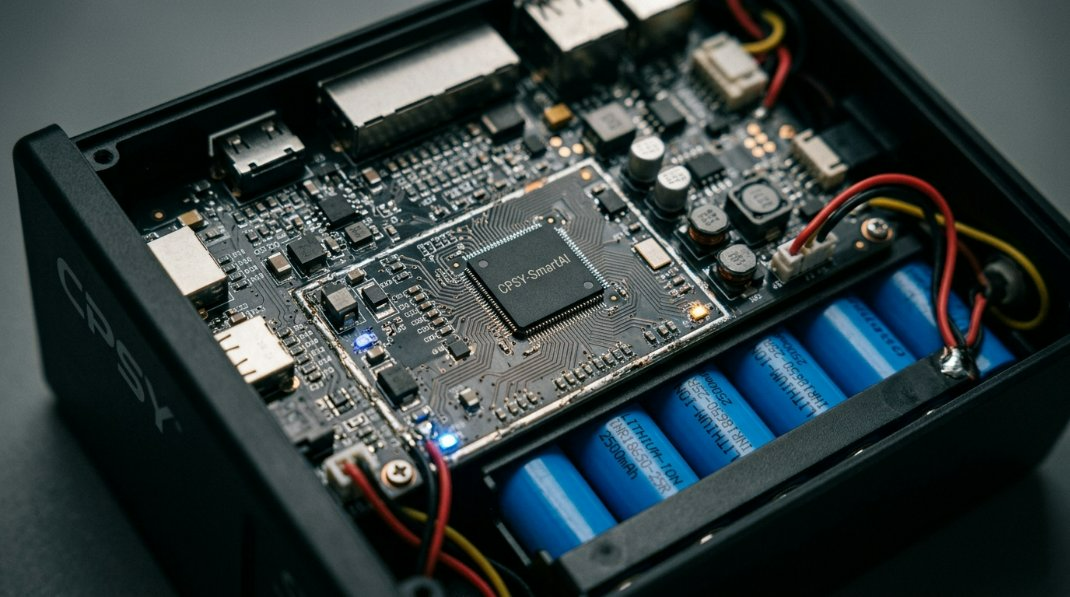
Proprietary Innovation: The CPSY-SmartAI Intelligent Control Protocol for 12V Mini UPS
To optimize thermal management and battery health in remote deployments, CPSY has integrated its groundbreaking, proprietary CPSY-SmartAI Intelligent Control Protocol. Unlike standard pass-through charging designs, this smart logic layer acts as a digital brain inside the 12V Mini UPS, continually monitoring dynamic impedance, internal heat buildup, and electrical loads.
How AI-Driven Smart Battery Management Maximizes B2B Lifecycle and Performance
By continually calculating state-of-charge (SoC) curves, the CPSY-SmartAI Intelligent Control Protocol manages the charging path dynamically. It facilitates our signature rapid-charging capability, which cuts empty-to-full cycle periods by up to 50% compared to standard architectures. Furthermore, the intelligent protocol monitors battery cell aging in real-time, adapting the float voltage to prevent micro-dendrite growth within the cells. For commercial enterprise networks, this guarantees a longer service lifespan, decreasing field dispatch frequencies and reducing the total cost of ownership (TCO) across thousands of nodes.
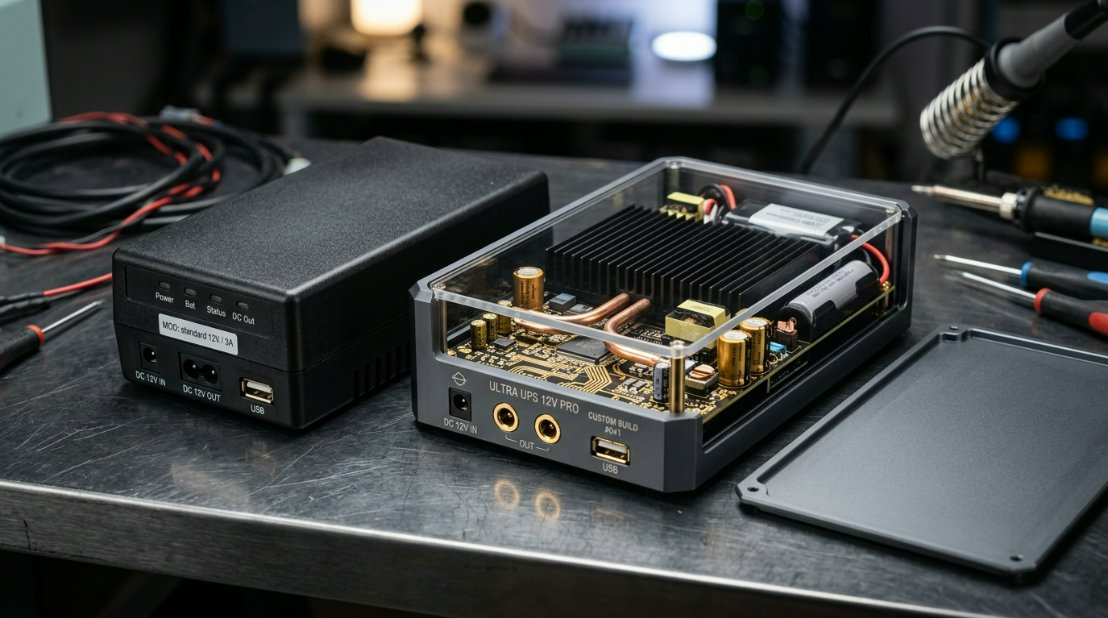
Technical Comparison Matrix: Standard Lithium-Ion vs. Advanced UL-Certified LiFePO4
Understanding the fundamental battery chemistries available determines structural longevity and deployment environments. Below is a highly-detailed technical comparison designed for procurement teams assessing standard lithium installations against our premium, custom UL-certified Lithium Iron Phosphate (LiFePO4) models.
| Technical Specification | Standard Lithium-Ion (NMC) | Advanced UL-Certified LiFePO4 (CPSY) |
|---|---|---|
| Thermal Runaway Temp | ~210°C (410°F) | ~270°C (518°F) - Ultra Safe |
| Cycle Life (80% DoD) | 300 to 500 Cycles | 2,000 to 3,000+ Cycles |
| Chassis Options | Standard Plastic Only | Flame-Retardant ABS or Custom Metal Alloy |
| Charge Efficiency Rate | Baseline Standard (Slow) | 50% Charge Time Reduction via CPSY-SmartAI |
| Warranty Cover | Typically 6 to 12 Months | 2-Year Electronics & 1-Year Battery Warranty |
OEM/ODM Specification Guide: Securing Premium Specs for US Distributors
We supply bespoke OEM/ODM 12V Mini UPS engineering options to match distinct distribution portfolios. This includes custom structural engineering (such as lightweight industrial plastic or rugged, impact-resistant metal alloys), custom packaging, custom color layouts, and high-capacity long-run models built to operate under harsh outdoor temperature thresholds.
Electrical Calculation Guidance: Accurately Sizing Your 12V Mini UPS Power Supply
To avoid premature battery exhaustion or hardware shutdowns during a grid outage, engineering teams must properly size the backup parameters based on connected loads.
Mathematical Formula for Calculating Backup Time, Exact Wattage, and Load Capacity
Calculating operational runtime requires determining real-world load configurations and matching them with your product specifications. The foundational formula utilized by engineers to approximate continuous UPS operation is structured below:
Runtime (Hours) = (Battery Capacity [Wh] * Efficiency Constant [η]) / Connected Load [Watts]

Where:
- Battery Capacity (Wh) = Nominal Battery Voltage (V) * Ampere-Hour Rating (Ah)
- Efficiency Constant (η) = Usually 0.85 to 0.90 (representing conversion loss & thermal dissipation)

Example Sizing:
- UPS Battery Pack: 12V, 5.2Ah (62.4 Wh)
- Network Load (Modem + PoE Camera): 15 Watts
- Efficiency: 0.88

Runtime = (62.4 * 0.88) / 15 = 3.66 Hours of continuous backup power.
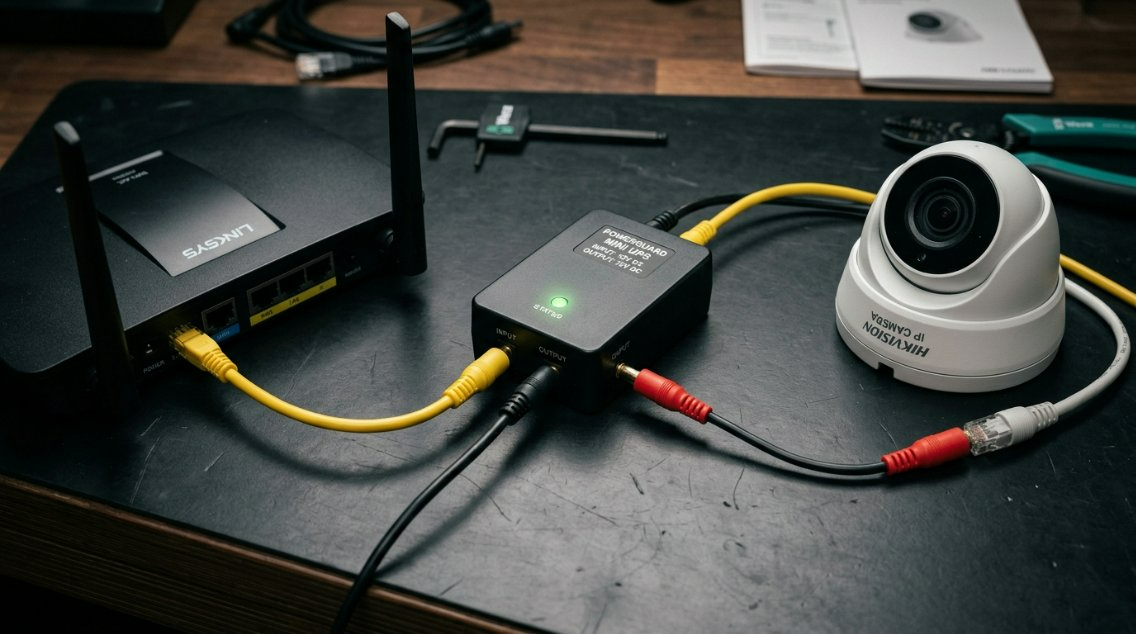
Practical Step-by-Step Tutorial: Seamless 12V Mini UPS Installation and Integration
Deploying the mini UPS in standard home or business settings is straightforward. Ensure compliance with local electrical safety regulations before starting the physical setup.
4-Step Mechanical Connection Guide for Routers, CCTV, and Smart Home Hubs
- Assess Power Requirements: Check the rating label on your terminal appliance (e.g., router or CCTV security camera). Confirm it is specified for exactly 12V DC input and its peak current draw (Amps) fits the rated output limit of your UPS.
- Connect the AC Power Adapter: Connect the original 12V AC/DC wall adapter to the UPS input port. Turn the main wall outlet switch on. The internal battery charging indicator on your CPSY UPS will illuminate, demonstrating that the 50% faster charging cycle has begun.
- Bridge the DC Output: Plug the provided DC male-to-male terminal bridge cable into the UPS 12V output port, and insert the opposite side directly into your endpoint network router or smart hub.
- Execute Functional Testing: With the equipment active, simulate an outage by switching off the source wall breaker. The integrated boost and buck AVR system and internal transfer switch will instantly maintain clean, continuous 12V power without interrupting network connectivity.
2026 Compliance & Regional Standards: UL, FCC, CE, RoHS, and Safety Certifications
Distributing telecom and hardware products in the US and EU markets requires strict adherence to international safety standards. Our products comply with RoHS and CE standards, preventing the use of hazardous substances in consumer electronics. Additionally, our factories follow strict manufacturing quality standards, ensuring every component of our 12V Mini UPS is safe to deploy in mission-critical networks.
Frequently Asked Questions (FAQ): Advanced Integration & Safety Specifications
Is the 12V Mini UPS compatible with Matter standard, Apple HomeKit, and Amazon Alexa smart ecosystems?
Yes. The physical power supply remains entirely transparent to higher-level smart protocols. Since it outputs direct current (12V DC) straight to smart home hubs or routers, any connected Matter, Apple HomeKit, or Alexa systems will continue to function reliably during local grid failure events.
What are the exact thermal cutting tolerances and safety instructions for custom OEM enclosures?
Our custom OEM plastic and metal casings are integrated with thermal protection thresholds managed by the CPSY-SmartAI system. If internal cell temperatures reach 60°C (140°F), the controller throttles input currents. It triggers a complete safety shutdown if temperatures exceed 75°C (167°F), protecting physical components from degradation or thermal hazards.
How does UL compliance impact B2B wholesale distribution in the United States?
UL certification provides assurance of mechanical and electrical safety for wholesale buyers and utility operators. Utilizing UL-compliant UPS hardware simplifies municipal safety inspections, streamlines commercial insurance requirements, and opens doors to bidding on state and federal telecom infrastructure projects.
Looking for Custom Engineering/OEM Solutions?
As a top-tier professional manufacturer, we deliver direct factory-price solutions for dynamic scaling, engineering projects, and custom systems globally.
Visit Official Website →