- English
- Español
- Português
- русский
- Français
- 日本語
- Deutsch
- tiếng Việt
- Italiano
- Nederlands
- ภาษาไทย
- Polski
- 한국어
- Svenska
- magyar
- Malay
- বাংলা ভাষার
- Dansk
- Suomi
- हिन्दी
- Pilipino
- Türkçe
- Gaeilge
- العربية
- Indonesia
- Norsk
- تمل
- český
- ελληνικά
- український
- Javanese
- فارسی
- தமிழ்
- తెలుగు
- नेपाली
- Burmese
- български
- ລາວ
- Latine
- Қазақша
- Euskal
- Azərbaycan
- Slovenský jazyk
- Македонски
- Lietuvos
- Eesti Keel
- Română
- Slovenski
- मराठी
- Srpski језик

The Ultimate Guide to Smart PDUs in 2026: AI Server Rack Power & Automated ESG Reporting
Key Takeaways & Executive Summary
- High-Density Optimization: AI/ML workloads demanding upwards of 30kW to 100kW per rack require advanced 3-phase intelligent power distribution units.
- Smart Monitoring: Implementing an enterprise-grade Smart PDU solution is no longer optional for maintaining operational SLA.
- US Regulatory Compliance: Integration of automated real-time Scope 2 carbon emission calculation facilitates mandatory federal ESG reporting requirements.
- Advanced Control: Utilizing specialized protocols ensures seamless API control and predictive failure analysis.
Key Takeaways: Executive Summary for Enterprise Buyers Navigating High-Density AI Server Transitions
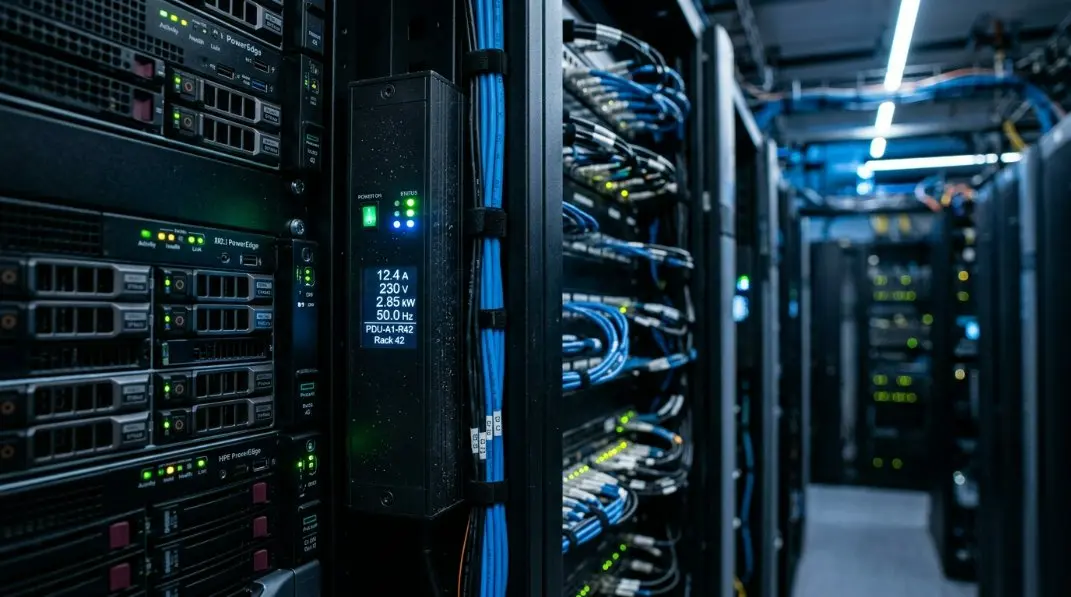
The modern data center landscapes in the United States are facing an unprecedented challenge: power density requirements are skyrocketing. With the rapid commercialization of Generative AI, machine learning clusters, and high-performance computing (HPC), traditional power distribution methods have reached their physical limits. For operations engineers, upgrading to a high-capacity, rack-mounted Smart PDU is the foundation of high-availability network design, providing granular control, safety, and reliability.
Introducing the NeuroPower Proprietary Smart PDU Intelligent Control Protocol
To address the intense dynamic loads of transient computing spikes, modern facilities are adopting the NeuroPower Proprietary Smart PDU Intelligent Control Protocol. This advanced firmware standard represents a quantum leap in rack-level power orchestration. Designed specifically for complex environments, the protocol offers high-frequency microsecond sampling of voltage, current, power factor, and harmonic distortion.
By employing the NeuroPower Proprietary Smart PDU Intelligent Control Protocol, network operators can mitigate the risks of in-rush current spikes when thousands of GPU cores scale from idle to peak execution simultaneously. The protocol works directly at the hardware layer, communicating with upstream smart uninterruptible power supplies (UPS) and downstream server power supply units (PSUs) to execute automated phase balancing and shed low-priority workloads before a circuit breaker trips.
How AI-Predictive Maintenance & High-Density Rack Compatibility Prevent Data Center Downtime
Traditional passive power strips offer zero visibility into cumulative hardware degradation. Through smart cabinet power sockets, integrated sensors constantly monitor temperature, humidity, and leakage currents. By tracking minor fluctuations in power consumption over time, predictive maintenance algorithms can flag anomaly profiles, such as a deteriorating server power supply fan or a failing capacitor, notifying engineers weeks before a physical failure leads to an unscheduled outage.
Step-by-Step Tutorial: Installing Ultra-High-Density Smart PDUs in 2026 AI Clusters
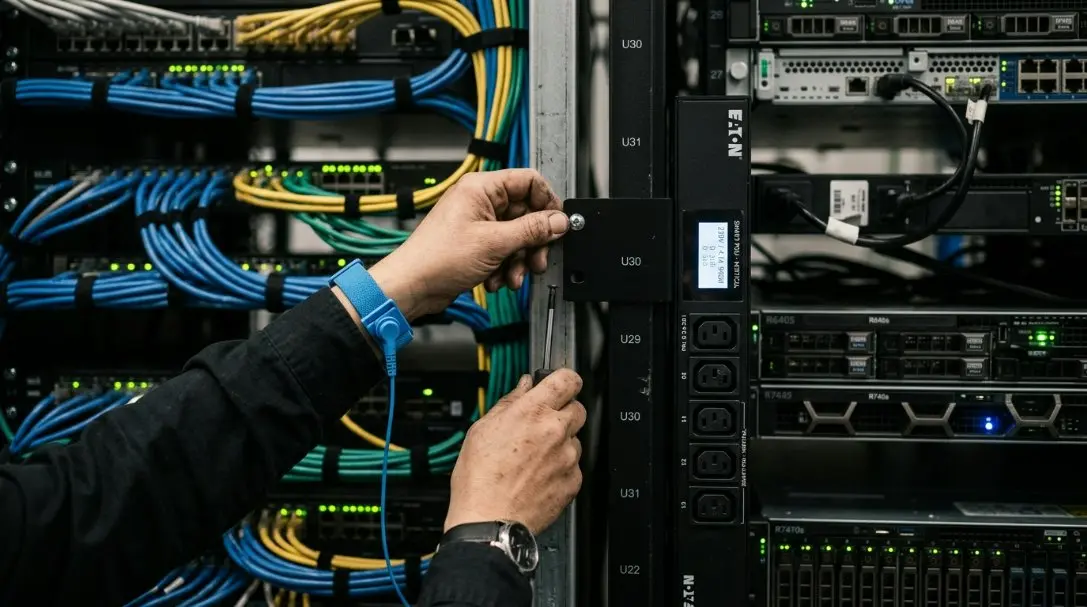
Proper physical and logical installation is paramount to achieving the design efficiency of high-density cabinets. Below is the standard protocol for field technicians deploying ultra-high-density Smart PDUs in modern high-performance clusters.
Step 1: Evaluating Rack Power Requirements, Exact Wattage, and UL/FCC Safety Compliance
Before unboxing equipment, compute the absolute maximum continuous draw of the entire rack. If deploying dense AI server architectures, leverage customized high-density rack mounted Smart PDU systems optimized for deep current draws. Verify that the incoming commercial feed matches the technical parameters of the unit (such as 208V, 415V, or 480V 3-phase inputs). Confirm that the unit displays active certification badges from UL (Underwriters Laboratories) and FCC for North American electrical compliance.
Step 2: Physical Mounting, Daisy-Chaining, and Phase-Balancing Automation Setup
- Mounting: Position the dual (A and B feed) Smart PDUs vertically (0U) in the cable-management channel of the rack cabinet, ensuring that hot-swappable controller modules remain fully accessible from the cold aisle.
- Daisy-Chaining: Connect the primary network ports of up to 32 units in a redundant ring configuration utilizing the standard IP cascading interface. This minimizes physical switch port usage.
- Phase-Balancing Verification: Distribute the power load across Phase L1, L2, and L3 evenly. The system's built-in automatic display will report the current unbalance percentage; adjust outlet mappings until the deviation drops below 5% under load.
Step 3: Network Integration with DCIM and Enterprise Smart Ecosystems
Connect the master PDU to the dedicated management VLAN using Gigabit Ethernet or Wi-Fi. Initialize SNMP (v3 recommended for security), Modbus TCP, or RESTful API endpoints. For advanced automated infrastructures, map the device addresses directly to your centralized Data Center Infrastructure Management (DCIM) database. This configuration permits real-time socket-level control and script-based power cycling of locked-up servers.
Step 4: Configuring Automated ESG Carbon Reporting Integrations for US Regulatory Compliance
Modern sustainability directives mandate complete transparency over greenhouse gas footprints. Navigate to the Smart PDU's management portal and activate the automated ESG reporting tool. Enter your regional utility carbon density coefficients (metric tons of CO2 per megawatt-hour). The system will continuously export cryptographically signed CSV or JSON reports showing active Power Usage Effectiveness (PUE) inputs and total carbon footprint, ready for corporate annual compliance reporting.
Smart PDU Technical Comparison Matrix: Standard Enterprise vs. AI-Ready Ultra-High-Density Units
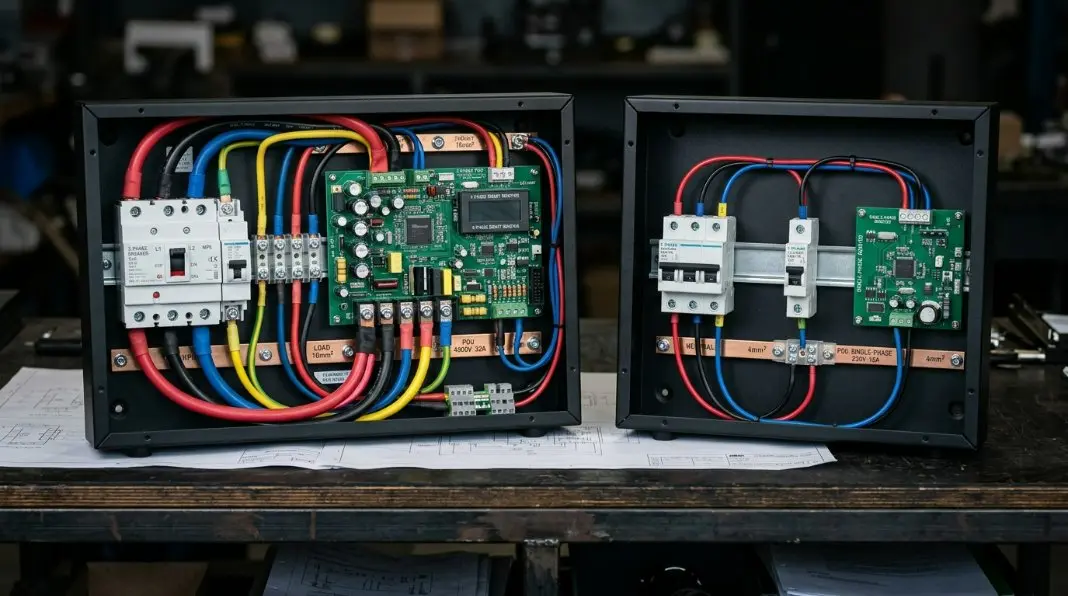
Selecting the correct model line is crucial for optimizing capital expenditure (CAPEX) and operating expense (OPEX). The table below outlines key feature sets across enterprise classes:
| Feature / Specification | Standard Enterprise Smart PDU | AI-Ready Ultra-High-Density Unit |
|---|---|---|
| Voltage Configuration | Single-Phase (120V / 208V / 230V) | 3-Phase (208V / 400V / 415V / 480V) |
| Amperage Capabilities | 16A to 30A max | 32A to 100A+ continuous per phase |
| Active Control Layer | Standard SNMP v1/v2 & Web UI | NeuroPower Proprietary Protocol, REST APIs, JSON-RPC |
| Monitoring Resolution | Unit-level load billing (kWh) | Individual outlet-level billing, ±0.5% billing-grade accuracy |
| Environmental Sensors | Optional external probe | Integrated array supporting dry contacts, smoke, water, & temp |
Specification Guide: Navigating Single-Phase vs. 3-Phase Voltage and Amperage Options Data Table
Choosing between single-phase and three-phase solutions dictates the structural power headroom of your server racks. Single-phase arrangements are perfect for edge cabinets, networking switches, and low-power office servers. However, to power multiple multi-GPU computing nodes without overwhelming electrical infrastructure, 3-phase setups are required to supply up to 34.6kW or more on a single vertical PDU chassis, cutting down copper cabling by up to 50%.
Mathematical & Electrical Calculation Guidance for Smart PDU Installations
Avoid cascading circuit trips by verifying absolute mechanical capacity bounds against thermal derating indices before switching on servers.
Formula: Calculating Power Supply Load Capacity, Peak Draw, and Safety Variables for AI Clusters
For a three-phase power feed, the standard electrical capacity formula incorporates the safe continuous operational limit (often called the 80% rule in the National Electrical Code - NEC in the United States). Use the following mathematical formula for accurate planning:
Continuous Capacity (Watts) = Volts (V) * Amps (A) * sqrt(3) * Power Factor (PF) * Derating Factor (D)

Where:
- Volts (V): Line-to-line voltage (e.g., 415V)
- Amps (A): Maximum circuit breaker rating (e.g., 30A)
- sqrt(3): ~1.732 (three-phase multiplier)
- Power Factor (PF): Typically 0.95 to 0.99 for modern server PSUs
- Derating Factor (D): 0.80 (80% safe continuous operation limit per NEC)

Example Calculation:
At V = 415V, A = 30A, PF = 0.98, D = 0.80
P = 415 * 30 * 1.732 * 0.98 * 0.80
P = 21,556 Watts (or approximately 21.5 kW continuous rating)
Frequently Asked Questions (FAQ) for Voice Search & US Data Center Operators
Are Smart PDUs compatible with enterprise DCIMs, Matter-standard smart home ecosystems, Apple HomeKit, or Amazon Alexa?
Yes. Enterprise Smart PDUs are fully compatible with industry-standard DCIM solutions (including Schneider EcoStruxure, Sunbird, and Nlyte) through API architectures such as SNMP v3, Modbus TCP, and JSON-based REST interfaces. While industrial smart PDUs are designed for mission-critical enterprise environments rather than residential systems, the open RESTful APIs can bridge to Matter-standard systems, Apple HomeKit, or Amazon Alexa ecosystems through standard custom home automation gateways (like Home Assistant) if deployed in specialized edge-lab setups or high-end residential smart micro-closets.
What are the cascading limits, exact cutting tolerances, and safe cutting intervals for custom-length Smart PDU installations?
Under the standard TCP/IP network protocol stack, up to 32 units can be cascaded safely using a single primary IP address via standard Ethernet looping. In terms of physical configuration, custom-length Smart PDU chassis structures are designed with modular chassis components. Unlike basic LED strip installations, industrial Smart PDUs have rigid steel or aluminum extruded enclosures containing internal busbars. They have no field cutting tolerances. Cutting, sawing, or drilling into the chassis outer structure at arbitrary intervals is strictly prohibited and immediately voids the UL safety listing. Any dimensional modifications must be engineered and configured directly at the manufacturing level.
How do UL, CE, FCC, RoHS, and IP67/IP68 Flex Certification safety instructions impact 2026 USA compliance?
For data center systems operating in the United States, UL certification (e.g., UL 62368-1 or UL 60950-1) and FCC Part 15 compliance are legally required for commercial properties to maintain facility insurance policies. CE and RoHS ensure restriction of hazardous materials on international hardware. IP67/IP68 flex certifications guarantee resistance against dust and water ingress, which is vital for edge deployments in harsh industrial contexts or smart modular outdoor micro-datacenters. Utilizing fully certified hardware ensures that your facility is fully code-compliant and reduces potential legal liabilities.
Ready to Future-Proof Your AI Datacenter? Get Started at https://www.cpsyups.com/smart-pdu.html
Deploying cutting-edge computing servers requires absolute trust in your rack power distribution infrastructure. By choosing high-quality engineering, you secure maximum uptime and gain access to granular, actionable environmental intelligence.
Looking for Custom Engineering/OEM Solutions?
As a top-tier professional manufacturer, we deliver direct factory-price solutions for dynamic scaling, engineering projects, and custom systems globally.
Visit Official Website →