- English
- Español
- Português
- русский
- Français
- 日本語
- Deutsch
- tiếng Việt
- Italiano
- Nederlands
- ภาษาไทย
- Polski
- 한국어
- Svenska
- magyar
- Malay
- বাংলা ভাষার
- Dansk
- Suomi
- हिन्दी
- Pilipino
- Türkçe
- Gaeilge
- العربية
- Indonesia
- Norsk
- تمل
- český
- ελληνικά
- український
- Javanese
- فارسی
- தமிழ்
- తెలుగు
- नेपाली
- Burmese
- български
- ລາວ
- Latine
- Қазақша
- Euskal
- Azərbaycan
- Slovenský jazyk
- Македонски
- Lietuvos
- Eesti Keel
- Română
- Slovenski
- मराठी
- Srpski језик

IT Network Rack Cabinets: High-Capacity 19-Inch Enclosures
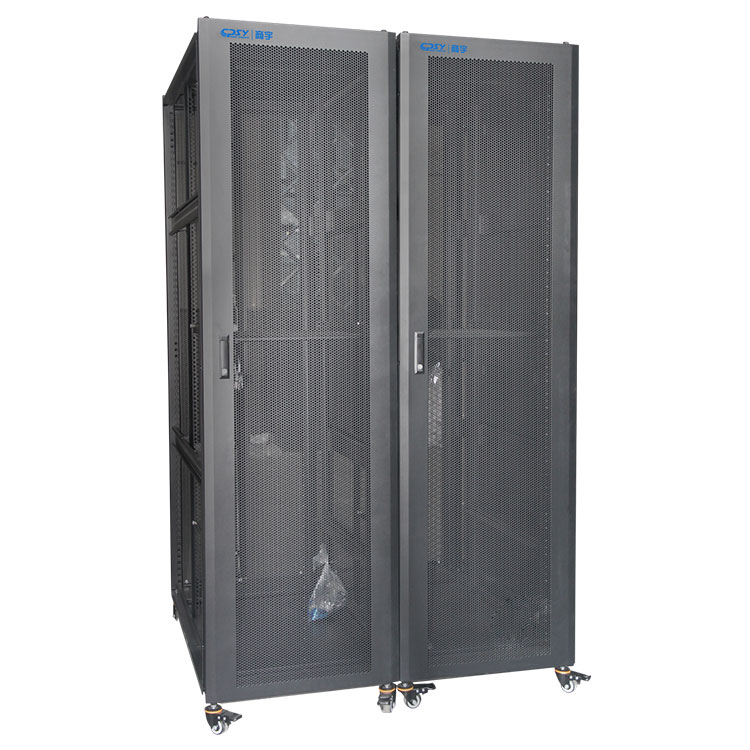
An IT network rack cabinet from CPSY is a 19-inch cold-rolled steel enclosure engineered to hold 1500kg to 1600kg of active data center equipment while resisting intensity 8-9 seismic events. Most infrastructure failures do not start with a software fault; they start with mechanical sag. When facility managers load standard aluminum frames with dense storage arrays and uninterruptible power supplies, the metal flexes. Mounting rails drift out of alignment. Hot-swappable drives jam in their chassis, and doors refuse to close, disrupting the hot-aisle containment perimeter.
CPSY solves this structural deficit by treating the server rack as a load-bearing foundation rather than a simple organizational shelf. These cabinets integrate heavy-duty weight distribution, IP-rated environmental protection, and the physical clearances required for high-density thermal management.
Core Specifications of CPSY Heavy-Duty Server Racks
Evaluating an enclosure requires looking past the standard 19-inch Electronic Industries Alliance (EIA) mounting width. The actual performance of a rack dictates how densely you can pack compute resources before risking structural failure or thermal throttling. Below are the baseline parameters that separate high-capacity infrastructure from light-duty telecom closets.
| Specification | CPSY Standard | Operational Impact |
|---|---|---|
| Material Construction | Cold-Rolled Steel | Maintains tight dimensional tolerances; prevents rail torsion under heavy, uneven loads. |
| Static Load Capacity | 1500kg – 1600kg | Supports full 42U/48U populations of dense 1U/2U GPU servers or lead-acid battery banks without chassis deformation. |
| Seismic Resistance | Intensity 8-9 Rating | Prevents catastrophic rack collapse and server ejection during violent lateral floor shifts. |
| Ingress Protection | IP20 / IP42 Options | IP20 secures standard clean-room data centers; IP42 protects edge deployments from falling water and large particulate ingress. |
| Cooling Integration | Hot/Cold Aisle Ready | High-perforation doors (up to 80% open area) and internal routing for liquid cooling manifolds. |
Structural Engineering for 1500kg Loads and Seismic Resistance
Density is the defining metric of modern computing. As enterprise facilities replace lightweight switches with heavy machine-learning clusters, the physical demands on the rack multiply. A cabinet failing under load does not just bend—it transfers that mechanical stress directly into the delicate silicon and fiberglass chassis bolted to it.
Cold-Rolled Steel Frames and Weight Distribution
CPSY relies on cold-rolled steel because the manufacturing process yields a metal with precise thickness and superior tensile strength compared to hot-rolled alternatives. When you rack 1500kg of hardware, the weight rarely distributes evenly. Technicians often cluster heavy battery backups or power distribution units near the bottom, while routing dense copper and fiber bundles near the top. This creates complex shear forces across the vertical uprights.
The cold-rolled frame manages this through rigid, multi-folded profiles. Instead of simple L-brackets, the vertical posts use complex geometric folds that resist torsion. The load transfers down through heavy-duty casters and adjustable leveling feet, ensuring that even on slightly uneven raised data center floors, the vertical rails remain perfectly plumb. If the rails drift even a few millimeters out of square, sliding server rails bind, turning routine maintenance into a physical struggle.
Surviving Intensity 8-9 Seismic Events in Data Centers
Earthquakes destroy infrastructure through violent oscillation and lateral shear. If a data center floor moves rapidly, a fully loaded 42U rack acts like a 1500kg pendulum. Without proper bracing, the cabinet sways, snapping network cables, tearing power cords from their sockets, and eventually collapsing under its own momentum.
CPSY engineers these cabinets to an 8-9 intensity seismic effect. This involves specific structural interventions:
- Reinforced Corner Joints: Heavy-gauge steel gussets prevent the rectangular frame from skewing into a parallelogram during lateral shaking.
- Anchored Base Plinths: The racks bolt directly into the structural floor or reinforced seismic platforms, bypassing the fragile raised-floor tiles.
- Vibration Dampening: The frame isolates high-frequency tremors, reducing the shock transferred to spinning hard disk drives, which are notoriously vulnerable to read/write head crashes during seismic events.
Buyers frequently mistake static load capacity for dynamic load capacity. A rack might hold 1500kg perfectly still, but surviving an earthquake requires the frame to manage that same 1500kg while it is violently accelerating and decelerating. CPSY's seismic bracing accounts for these dynamic forces.
Thermal Management and Environmental Controls
Moving air through a densely packed cabinet is a zero-sum game. If you block the exhaust, the servers choke, spin their fans to maximum, and eventually trigger thermal shutdowns. The physical cabinet must facilitate, rather than obstruct, the facility's cooling strategy.
Integrating Liquid Cooling Manifolds for 2026 AI Workloads
Air cooling hits a physical wall at roughly 20kW to 30kW per rack. The latest generation of AI and high-performance computing hardware pushes cabinet densities well beyond 50kW. To handle this, facilities are shifting to direct-to-chip liquid cooling or rear-door heat exchangers.
This fundamentally alters what a rack must do. You are no longer just managing Cat6 cables; you are plumbing heavy, fluid-filled pipes. CPSY enclosures accommodate this shift by providing expanded side and rear channels designed specifically for Coolant Distribution Units (CDUs) and vertical manifolds. The 1500kg load capacity becomes critical here, as the addition of water or engineered dielectric fluids adds hundreds of kilograms of static weight to the frame. Furthermore, the precise rail alignment of the cold-rolled steel prevents the chassis flex that often causes drip-free quick-disconnect valves to bind and leak.
Dynamic Monitoring and IP42 Protection Ratings
Not every cabinet lives in a pristine, climate-controlled hyperscale facility. Edge computing pushes racks into telecom closets, warehouse floors, and light industrial spaces. These environments require different defenses.
CPSY offers cabinets with an IP42 protection rating. The "4" indicates protection against solid objects larger than 1mm—keeping out stray wires, tools, and heavy conductive dust. The "2" indicates protection against water falling at up to a 15-degree angle, shielding critical hardware from overhead pipe condensation, minor roof leaks, or accidental spills.
Because higher IP ratings naturally restrict airflow, these cabinets integrate tightly with dynamic environment monitoring systems. Sensors track temperature gradients from the bottom to the top of the rack, monitor relative humidity, and log door access. If the internal temperature spikes because the sealed environment is retaining too much heat, the monitoring system triggers alerts before the servers throttle. The trade-off is unavoidable: if you seal the rack from external dust and water, you must implement active, monitored cooling inside the enclosure.
Deployment Scenarios for Fully Sealed Network Cabinets
Using a fully sealed IT network cabinet is a specific architectural decision with clear operational trade-offs. Standard data centers rely on perforated doors to pull cold air from the front aisle and push hot air out the back. A fully sealed cabinet abandons this model entirely.
You deploy a sealed cabinet in environments where the ambient air is actively hostile to electronics. Factory floors filled with airborne metal shavings, chemical processing plants with corrosive vapors, or remote transit hubs exposed to heavy particulates demand closed-loop systems. In these scenarios, the CPSY cabinet acts as a standalone micro-data center. It relies on internal precision air conditioners (often side-mounted or bottom-mounted) to circulate and chill the air trapped within the steel walls.
The primary mistake buyers make here is underestimating the footprint. A sealed rack with an integrated cooling unit requires physical clearance for the air conditioner's compressor and exhaust routing for the rejected heat. It is a highly effective deployment strategy, provided you plan for the increased power draw and the modified floor space requirements.
Factory-Direct Sourcing, OEM Customization, and US Logistics
Procuring server racks at scale exposes a harsh logistical reality: when you ship a fully assembled cabinet across the ocean, you are mostly paying to transport empty space. Freight costs can easily exceed the manufacturing cost of the steel itself.
CPSY addresses this through flat-pack shipping. By breaking the rack down into its core structural components—base, roof, vertical uprights, and doors—the shipping volume drops dramatically. A standard shipping container that might hold 30 fully assembled racks can hold over 100 flat-packed units. This factory-direct supply chain keeps unit costs low for US buyers, though it requires factoring in local assembly time on the data center floor. For facilities with narrow freight elevators or standard commercial doors, flat-packing is not just a cost-saving measure; it is the only physical way to get a 42U or 48U rack into the room.
For B2B buyers in government, telecom, and finance, standard dimensions rarely fit every project. CPSY provides OEM IT network rack cabinet services, allowing buyers to customize depth, rail types, cable entry points, and branding. If you are standardizing a new deployment architecture and need enclosures built to specific thermal or load tolerances, factory-direct customization bypasses the limitations of off-the-shelf distributor inventory.
To spec your next data center build or request pricing on flat-pack logistics for US delivery, review the exact dimensions and load certifications at CPSY's cabinet engineering page.