- English
- Español
- Português
- русский
- Français
- 日本語
- Deutsch
- tiếng Việt
- Italiano
- Nederlands
- ภาษาไทย
- Polski
- 한국어
- Svenska
- magyar
- Malay
- বাংলা ভাষার
- Dansk
- Suomi
- हिन्दी
- Pilipino
- Türkçe
- Gaeilge
- العربية
- Indonesia
- Norsk
- تمل
- český
- ελληνικά
- український
- Javanese
- فارسی
- தமிழ்
- తెలుగు
- नेपाली
- Burmese
- български
- ລາວ
- Latine
- Қазақша
- Euskal
- Azərbaycan
- Slovenský jazyk
- Македонски
- Lietuvos
- Eesti Keel
- Română
- Slovenski
- मराठी
- Srpski језик

Leading 12.8V LiFePO4 Battery Factory in China: Advancing Smart Municipal Lighting & 2026 EU Battery Passport Compliance
Key Takeaways & Executive Summary
- Market Leadership: CPSY is at the forefront of 12.8V LiFePO4 battery manufacturing, specializing in deep-cycle solutions for municipal and industrial use.
- Proprietary Tech: Integration of the CPS-BMS Precision Sync Protocol ensures superior safety and cell balancing.
- Compliance: Ready for the 2026 EU Battery Passport and strictly adhering to China 3C and GB standards.
- Versatility: Optimized for 4P4S configurations, expanding capacity for UPS, RV, and off-grid solar systems.
- Smart Connectivity: Real-time Bluetooth monitoring and IoT compatibility for smart city ecosystems.
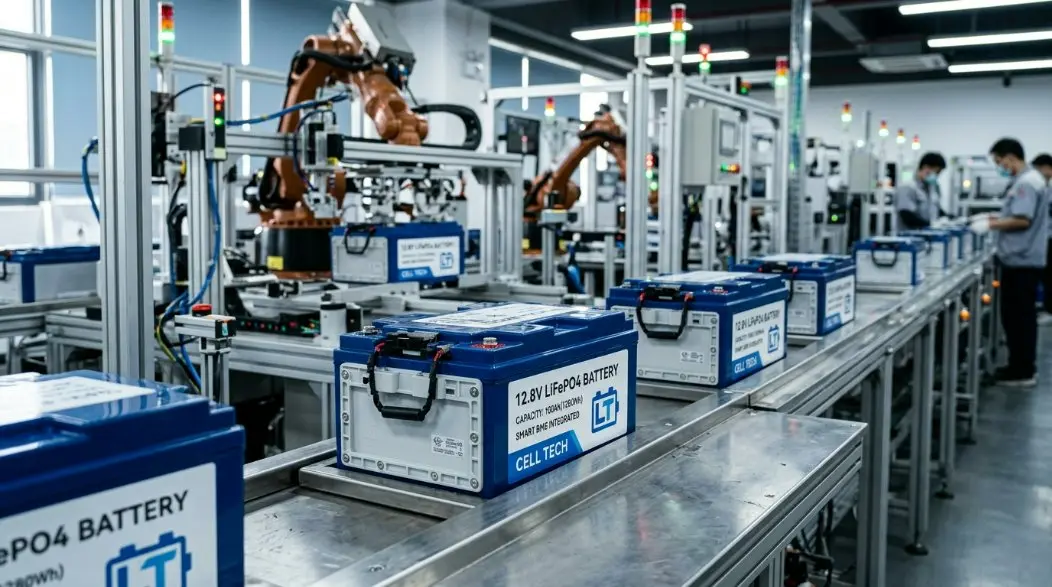
Key Takeaways: Executive Summary of Next-Generation 12.8V LiFePO4 Battery Manufacturing
In the evolving landscape of energy storage, the 12.8V LiFePO4 battery has emerged as the definitive successor to traditional lead-acid systems. As a premier China's premier 12.8V LiFePO4 battery manufacturer, we are redefining reliability through high-density lithium iron phosphate chemistry. These batteries provide more than just power; they offer an intelligent energy ecosystem designed for longevity, providing over 4,000 cycles at 80% Depth of Discharge (DOD).
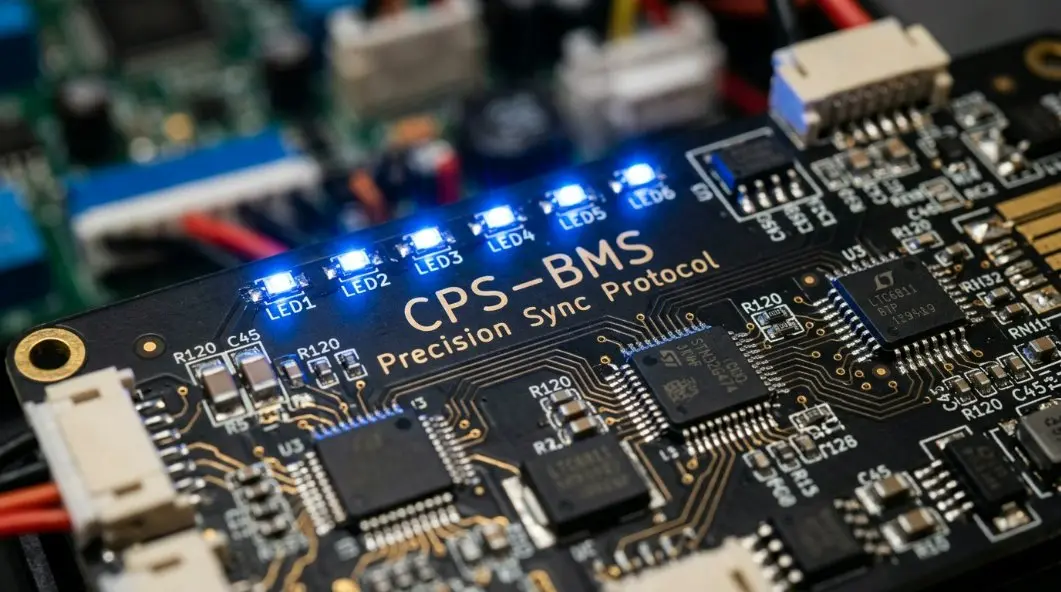
Core Innovation: The Proprietary CPS-BMS Precision Sync Protocol for 12.8V Systems
Our engineering team has developed the CPS-BMS Precision Sync Protocol, a cutting-edge control architecture that manages individual cell health with microsecond responsiveness. Unlike standard BMS units, this proprietary system utilizes active balancing to ensure that every cell within the 4S configuration remains within a 20mV tolerance. This protocol is critical for high-demand applications like municipal street lighting and remote telecommunications where failure is not an option.
Bridging the Gap: Real-Time Factory Automation and Smart IoT Integration
By integrating Bluetooth 5.0 and specialized IoT gateways, our custom 12.8V LiFePO4 battery solutions allow for remote monitoring via cloud-based platforms. This enables facility managers to track state-of-charge (SOC), temperature, and cycle counts across thousands of units simultaneously, bridging the gap between hardware and smart city digital twins.
Step-by-Step Tutorial: Installing and Waterproofing 12.8V LiFePO4 Batteries for Municipal Solar Lighting
-
Step 1: Pre-Installation Capacity Check and GB Quality Codes Verification
Before deployment, verify the battery's manufacturing batch and capacity using the QR code on the casing. Ensure the voltage is balanced across units if connecting in series. -
Step 2: Wiring the Intelligent BMS for Solar Controllers
Connect the battery to the MPPT solar controller. Ensure the CPS-BMS Precision Sync Protocol is recognized by the system for optimal charging curves. -
Step 3: Integrating Municipal IoT and Smart City Systems
Link the battery's communication port to the local IoT node. This allows the battery to report its status to the central municipal lighting control board. -
Step 4: Applying IP67/IP68 Waterproof Resealing Techniques for Extreme Weather
Apply specialized silicone sealants to the terminal connections and housing seams to prevent ingress during monsoon seasons or high-humidity environments.
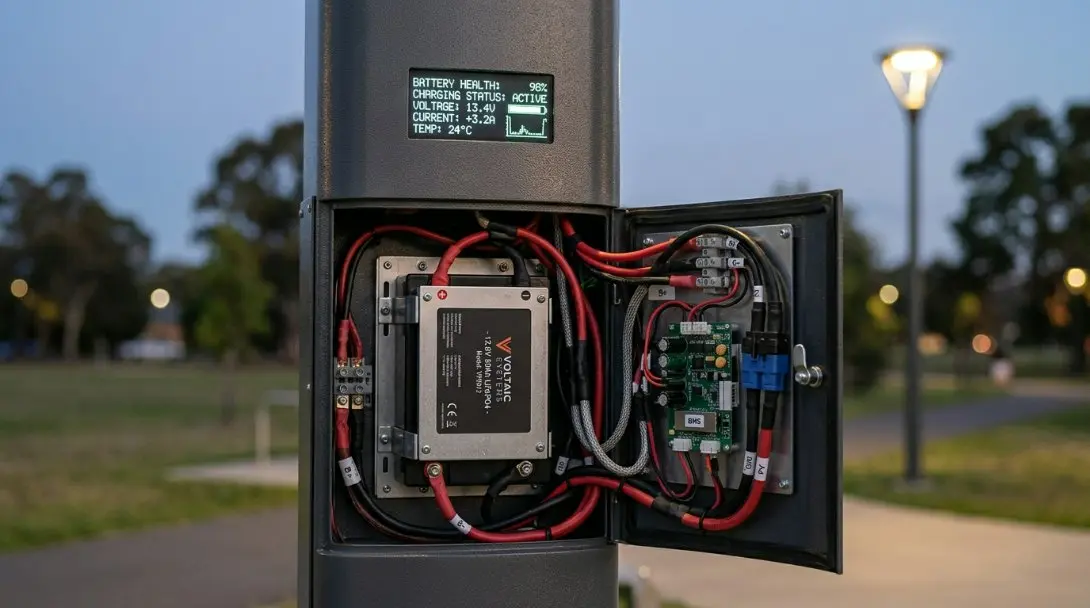
Technical Comparison Matrix: Standard 12.8V vs. Smart IoT-Integrated Specification Guide
| Feature | Standard 12.8V LiFePO4 | CPSY IoT-Integrated Model |
|---|---|---|
| Cycle Life (80% DOD) | 2,500 - 3,000 | 4,000+ |
| Monitoring | None / Voltage Only | Bluetooth/IoT/CPS-BMS Sync |
| Max Series Connection | 2S (25.6V) | 4S (51.2V) |
| Protection Level | IP54 | IP67 / IP68 Custom |
Electrical Calculation Guidance: Sizing Power Loads for Municipal Lighting
Accurate sizing is essential to prevent premature battery aging and system downtime. Follow these engineering formulas for precision deployment.
Mathematical Formulas for Safety Variables, Physical Wattage Loads, and Custom 12.8V Run-Time Capacity
1. Total Energy (Wh) = Capacity (Ah) × Nominal Voltage (12.8V)
2. Required Capacity (Ah) = (Load Wattage × Backup Hours) / (Efficiency Rate × DOD)
3. Maximum Load Current (A) = Continuous Discharge Current Rating of BMS
Example: (60W Light × 12 Hours) / (0.95 Efficiency × 0.80 DOD) = 94.7Ah (Select 100Ah Model)
Navigating 2026 EU Battery Passport, China 3C Certification, and Regional Standards
Compliance is no longer optional. The upcoming 2026 EU Battery Passport requires full transparency in the supply chain, from raw material extraction to recycling. Our 12.8V LiFePO4 batteries are already transitioning to this digital documentation standard, ensuring that B2B partners in Europe and North America can import with confidence. Furthermore, our products meet the strict China 3C certification and UN38.3 transport safety requirements.
Frequently Asked Questions (FAQ) on 12.8V LiFePO4 Battery Systems
How does the 12.8V LiFePO4 BMS integrate with smart home ecosystems like Xiaomi Mijia, Tuya Smart, and Apple HomeKit?
Our smart batteries utilize a bridging gateway that translates proprietary BMS data into Zigbee or Matter protocols, allowing seamless visibility within popular smart home apps for RV or off-grid home users.
What are the cutting tolerances, precise spacing per meter rules, and custom sizing for OEM battery packs?
For OEM applications, we maintain a +/- 1mm tolerance on housing dimensions. We provide custom spacing for modular racks to optimize airflow and thermal management in large-scale energy storage systems.
What are the strict safety instructions and power supply calculations for avoiding thermal runaway?
LiFePO4 is inherently stable; however, our CPS-BMS Precision Sync Protocol adds a secondary layer of protection that disconnects the battery if internal temperatures exceed 65°C or if cell-to-cell voltage variance exceeds 500mV.
Looking for Custom Engineering/OEM Solutions?
As a top-tier professional manufacturer, we deliver direct factory-price solutions for dynamic scaling, engineering projects, and custom systems globally.
Visit Official Website →