An outdoor integrated cabinet can simplify a network site because the enclosure, cooling, power distribution, UPS, battery backup, monitoring, wiring, and supporting provisions are planned as one equipment package rather than procured and fitted as disconnected parts. That matters most where field access is limited and a missed interface—between heat load and cooling, battery space and UPS, or cable entry and installed equipment—can delay commissioning.
Integration is not a shortcut around site engineering. You still need accurate load, heat, environmental, access, and maintenance information. It is a way to put those decisions in one coordinated design before hardware reaches the site.
The Short Answer: A Planned Cabinet Can Simplify Outdoor Site Delivery
Outdoor sites rarely fail because someone forgot that electronics need a cabinet. They fail at the handoffs. A power team selects distribution equipment, a network team adds active gear later, and the cooling arrangement or cable routes no longer match the actual installation. Battery service clearance is another frequent surprise.
With an integrated approach, the major subsystems are considered together. The cabinet has to house the equipment; cooling has to remove its expected heat; power distribution has to serve the installed loads; the UPS and backup battery arrangement have to fit the required continuity plan; and monitoring has to report conditions worth acting on. Fewer separate design handoffs can mean fewer compatibility questions during delivery and installation.
CPSY describes its outdoor cabinet offering for communications and outdoor network applications, with integrated cooling, cabinet, power distribution, UPS, backup battery, monitoring, wiring, and fire-protection subsystems. The useful buyer question is not “Is everything included?” It is “Does this configuration account for the equipment and site conditions I actually have?”
The Subsystems That Need to Work Together Outdoors
Enclosure, cooling, power distribution, UPS, and battery backup
The enclosure is the physical boundary for installed network equipment, but it also sets practical limits on layout, cable entry, heat management, and service access. Cooling cannot be selected in isolation: the heat produced by radios, switches, transmission equipment, power equipment, and other loads needs to be assessed alongside the site’s ambient conditions and cabinet arrangement. A cooling unit with a poor airflow path may leave hot areas around the gear that matters most.
Power distribution, UPS equipment, and batteries form another chain. Distribution needs enough appropriate circuits for present equipment and any agreed expansion. The UPS and battery backup arrangement must be chosen around the required backup objective, connected load, battery type, recharge expectations, and available cabinet space. CPSY’s broader product range includes UPS systems and LiFePO4 and VRLA batteries, but the right battery choice depends on the project—not a blanket preference.
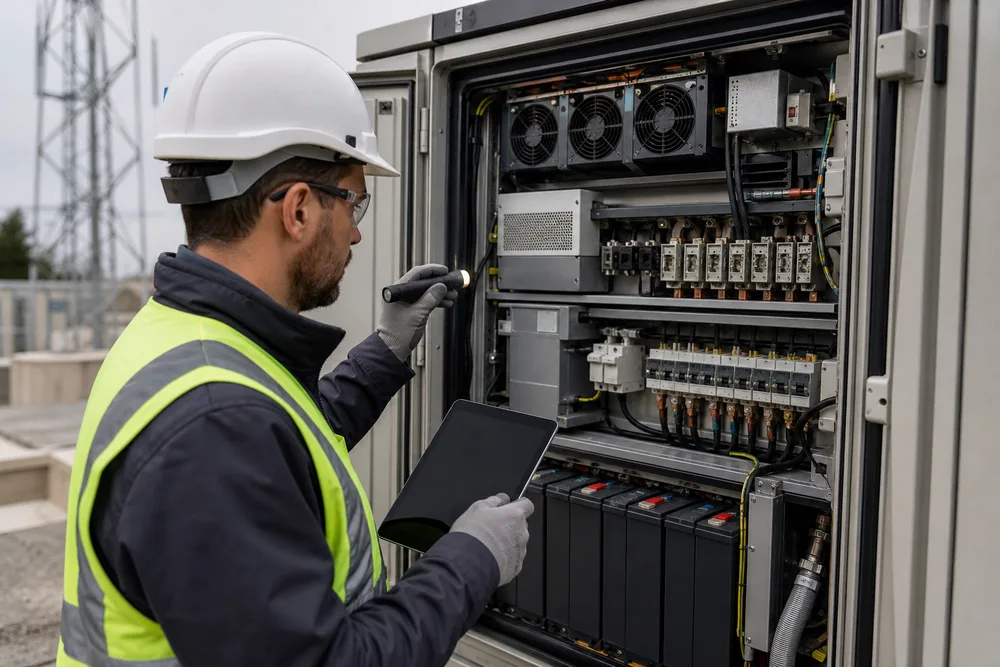
Buyers often focus on the headline backup requirement and overlook replacement access. If batteries, UPS modules, or distribution components cannot be safely reached without disturbing live network equipment, routine service becomes slower and more exposed to error.
Monitoring, wiring, fire-protection provisions, and service access
An outdoor cabinet environmental monitoring system can bring operating conditions into view instead of leaving a site as a black box between truck rolls. Useful monitoring may cover the parameters and alarms required by the deployment, such as environmental conditions, power status, access events, or equipment alarms. Decide early who receives those signals and how they connect to the existing network management process. Data without an owner does not improve uptime.
Internal wiring deserves the same discipline. Clear separation, route planning, labeling, grounding requirements, and cable-entry choices affect installation quality and fault tracing later. Fire-protection provisions should also be reviewed against the site owner’s rules and local requirements; do not assume that a generic cabinet arrangement settles a compliance obligation.
Deployment Scenarios That Benefit Most from Integration
Wireless, 5G, and edge network sites with limited field time
An outdoor telecom integrated cabinet is a practical fit for wireless and 5G locations where technicians have a narrow installation window, constrained space, or both. A planned cabinet reduces the number of separate assemblies that must be reconciled in the field. For an outdoor edge computing cabinet, the thermal review becomes especially consequential because compact computing and networking loads can concentrate heat in a small volume.
That does not mean every 5G site needs the same build. The installed radio and transport equipment, battery expectation, cooling method, communications interfaces, and access restrictions should drive the configuration. A standard cabinet can be the wrong answer if the site has unusual cable routing, a strict footprint, or a nonstandard power arrangement.
Rail, transportation, utility, and municipal communications installations
Rail transit, roadside transportation, utility, and municipal communications projects often introduce approval, access, and maintenance constraints that office-campus network sites do not have. A cabinet may need to support remote supervision, controlled physical access, defined maintenance procedures, and project-specific equipment layouts. Coordinating those needs in one package can reduce ambiguity between the cabinet supplier, electrical contractor, network integrator, and site operator.
Site rules still govern. Ask for the project documentation your owner or authority requires, and confirm the environmental exposure, installation location, cable interfaces, and maintenance permissions before finalizing the cabinet.
Integrated Cabinet or Separately Coordinated Site Equipment?
Separate equipment can be sensible where you already have approved enclosure, cooling, UPS, or monitoring standards and an experienced integrator responsible for the complete assembly. It may also suit a site that requires a highly unusual physical arrangement. The trade-off is that your team owns the interfaces between suppliers.
| Decision point | Integrated outdoor cabinet | Separately coordinated equipment |
|---|---|---|
| Design responsibility | Subsystem fit can be addressed as one configuration. | The project team coordinates fit across multiple selections. |
| Field installation | Can reduce on-site assembly and interface decisions. | May require more field coordination and verification. |
| Customization | Configuration should be reviewed against the actual site. | Individual components can be mixed, subject to compatibility work. |
| Service planning | Access to related systems can be planned together. | Service access depends on the final assembled layout. |
The comparison is not “integrated good, separate bad.” It is about accountability. If you want one planned package for the cabinet, cooling, power, backup, and monitoring interfaces, review a CPSY outdoor integrated cabinet. If separate suppliers are already specified, make sure one party is explicitly responsible for the final fit and test plan.
Confirm Site Conditions, Service Access, and Project Documentation Before Ordering
Use this short review before requesting a configuration:
- List the equipment to be installed now and the approved future additions, including power and heat-producing loads.
- Document the outdoor environment, installation position, available footprint, cable-entry direction, and utility power conditions.
- Define the required backup approach, then confirm battery type, space, replacement path, and UPS service access.
- Identify the monitoring points, communications interface, alarm recipients, and response responsibility.
- Provide site-owner, industry, and local requirements for enclosure protection, fire provisions, grounding, access control, and documentation.
- Ask for layout and interface documentation that your installer and maintenance team can use in the field.
A cabinet cannot correct unknown inputs. Good project information is what turns integration from a tidy product concept into a workable site installation.
Start a CPSY Outdoor Cabinet Configuration Review
Bring the equipment list, site conditions, backup expectations, monitoring needs, and service constraints to the first discussion. CPSY can review an outdoor cabinet configuration around communications and outdoor network applications, including the supporting systems that need to fit together. See the outdoor cabinet configuration options from CPSY to begin with the right project details.